
4.5 KiB
Advanced Encryption Standard (AES)
-
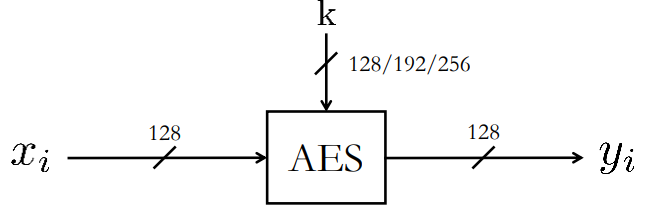
AES superseded DES as a standard in 2002
-
Uses rounds of 4 layers and a final round of 3
-
Bytes are represented as a 4x4 block called the state


Sub-Bytes - similar to s-boxes in DES
Shift Rows - diffusion and permutation round

First row doesn’t move, second row is shifted to the left by 1, the third row is shifted two places to the left etc
Then, when the columns are mixed, this means the overall diffusion is extremely good
The last round doesn’t have a mix column step as it's reversible and wouldn’t add additional security.
S-Box
- The AES s-box is based around the multiplicative inverse of 8-bit values in
GF(2^8) - This is a strongly non-linear mapping
A_i \cdot A_i^{-1} \equiv 1 \space (mod \space P(x)) \\
B'_i = \begin{cases}
0 \quad\quad\quad i=0 \\
A_i^{-1} \quad\space\space\space i > 0
\end{cases}

- Note: 0 maps to 0
- The inverses
B'_ithen undergo an affine transformation to produce the final s-box - This destroys any remaining mathematical structure

Remember an affine transformation is a multiplication and addition by two constants (think of the affine cipher)
S-box Properties
- The s-box is simply described, and is bijective, an invertible 1:1 mapping
- It has no fixed points
- i.e. no
A_ifor whichS(A_i) = A_i
- i.e. no
- No inverse fixed points
- i.e. no
A_ifor whichS(A_i) \oplus A_i = FF
- i.e. no
- Minimisation of the largest non-trivial correlation between linear combinations of input bits and linear combinations of output bits
- 0 is a non-trivial combination
- Minimisation of the largest non-trivial value in the
EXORtable- This stops differential cryptanalysis
AES Diffusion
Diffusion in AES consists of two layers:
- Shift rows
- Mix columns
Shift rows simply moves bytes around the block

Mix Columns
- Performs a linear mixing of bytes within each column
- All the input bytes in a column influence all the output bytes

- Multiplying by
01does not change the result
When multiplying by x, there’s a shortcut we can implement. We can set the equation equal to 0, and xor by x^4 - x^3 - x - 1

Key Schedule

- The first round key used is just the key
- We then take
W[3]and put it through thegfunction which just permutes itgtakes the word, shifts it one to the right and then passes it through the s-boxes- We then
xorit withRC[i]which is just a constant value to ensure something changes- Like for example if we had a bit stream of all 0s
Implementation
-
All additions and subtractions are
xor -
Multiplying by
01has no effect -
Multiplying by
02(which isx) is simply a left shift followed by modular reduction-
Left shift multiplies by
x -
If the original
x^7bit was set, then we mustxorwith0x1B -
Example:
// xtime
if ((a & 0x80) > 0) {
	a = (a << 1) ^ 0x1b;
} else {
	a <<= 1;
}
-
-
Multiplying by
03(x+1) is simplyxtime(a) ^ a
-
Inverse multiplications are by
09,11,13,14. These require either a more general function or lookup tables -
Consider the sum:
-
Product:
a = x^6 + x^4 + x^2 + 1 \\ b = x^7 + x^4 + x^2 + x \\ \therefore a\cdot b = a\cdot x^7 + a\cdot x^4 + a\cdot x^2 + a\cdot x -
Repeated multiplication:
a\curvearrowright a\cdot x \curvearrowright a\cdot x^2 \curvearrowright a\cdot x^3 \curvearrowright a\cdot x^4 \curvearrowright a\cdot x^5 -
Here in
a\cdot b,ais just being multiplied by various powers ofx. This can be easily calculated by repeatedly multiplyingabyx.
-
-
AES is very fast in software and pretty fast in hardware
-
CPU instructions in AES-NI make AES much faster
-
Much of the algorithm can be converted into a series of lookup tables
- Trade-off between speed and space
-
There are numerous cache-timing and other attacks possible
- Implementation must be constant time
- CPU instructions help mitigate this
-
In general AES is much harder to implement safely than
ChaCha20