
3.7 KiB
Content-Centric Networks
A Brief History of Networking
-
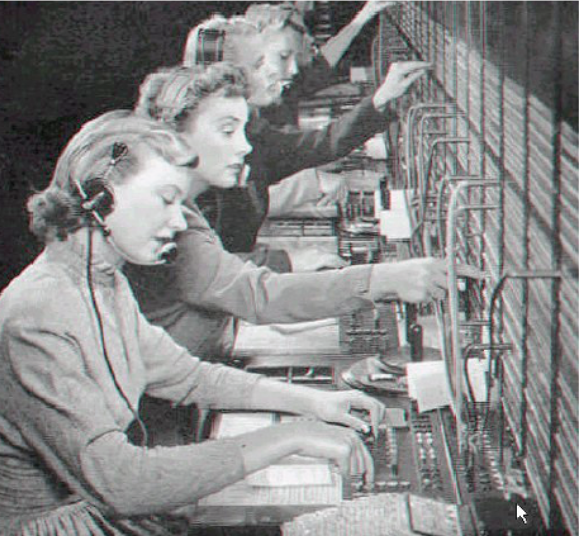
Gen 1. The phone system (focus on the wires)
-
The utility of the system depends on running wires to every home & office.
-
Wires are the dominant cost.
-
A call is not the conversation; it's the PATH between two end-office line cards.
-
A phone number is not the name/address of the caller; it's a program for the end-office switch fabric to build a path to the destination line card.
-
-
Path building is non-local and encourages centralisation and monopoly.
-
Calls fail if any element in the path fails, so reliability goes down exponentially as the system scales up.
-
Data cannot flow until the path is set up so efficiency decreases with setup time.
-
-
Gen 2. The Internet (focus on the endpoints)
- Data sent in independent chunks and each chunk contains the name of the final destination.
- Nodes forward packets onward using routing tables.
- ARPAnet was built on top of the existing phone system.
-
Gen 3. dissemination (focus on the data)

TCP/IP
Pros
- Adaptive routing lets system repair failures
- Reliability increases exponentially with system size.
- No call setup means high efficiency at any bandwidth and scale.
- Distributed routing supports any topology and tends to spread load and avoid a hierarchy's hot spots.
Cons
- Connected is a binary attribute.
- Becoming part of the internet requires a globally unique, globally known IP address that's topologically stable on routing time scales.
- Connecting is a heavyweight operation
- The net struggles with moving nodes
Conversation and Dissemination
Acquiring chunks of data (web pages, emails, videos etc) is not a conversation, it's dissemination.
In a dissemination the data matters, not the supplier.
- Data is requested by name.
- Anything that hears the request, and has a valid copy can respond.
- The return data is signed, so integrity and association can be validated.
CCN can run over and be run over anything e.g. IP.
CCN Packets

Interest - similar to HTTP GET
Data - similar to HTTP response
Content Based Security
Data packets are authenticated with digital signatures.

CCN Forwarding
The consumer broadcasts an interest over all available communication media.
- e.g.
get '/parc.com/van/presentation.pdf' - response:
heres '/parc.com/van/presentation.pdf/p1' <data>
Names and Meaning
- Like IP, CCN nodes impose no semantics on names
- Meaning comes from application, institution and global conventions reflected in prefix forwarding rules.
- Globally meaningful name leveraging the DNS global naming structure
/parc.com/van/presentation.pdf
- Local and context sensitive, it refers to different objects depending on the room you're in.
/thisRoom/projector
Strategy Layer
- When you do not care who you are talking to, you don't care if they change
- When you are not having a conversation, there's no need to migrate conversation state.
- Multi-point gives you multi-interface for free.
- When all communication is locally flow-balanced, your stack knows exactly what's working and how well.
In the current Internet, Quality of Service (QoS) Problems are highly localised
- Roughly half the problems are from serial dependencies created by queues
- The other half are caused by a lack of receiver-based control over bottlenecked links.
Unlike IP, CCN is local, doesn't have queues, and gives receivers complete control.

Tree serves as transport state