# Unified Modelling Language
12/10/20
**UML**: A specification defining a graphical language for visualising, specifying, constructing and documenting the artefacts of distributed object systems.
Latest version: **2.6**
**Benefits of UML**
- Enhances communication and ensures the right communication
- Captures the logical software architecture independent of the implementation language.
- Helps to manage the complexity
- Enables reuse of design
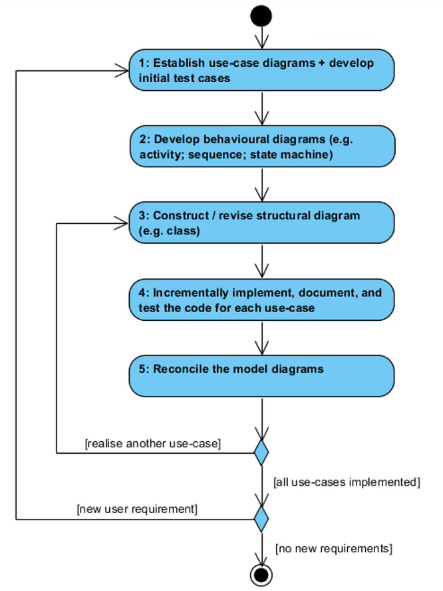 ## Object Orientated Analysis
**Use case diagrams**
- Describe a set of actions that some system should or can perform in collaboration with one or more external users of the system.
- No attempt to represent an order or a number of executions.
**Use case diagram components**
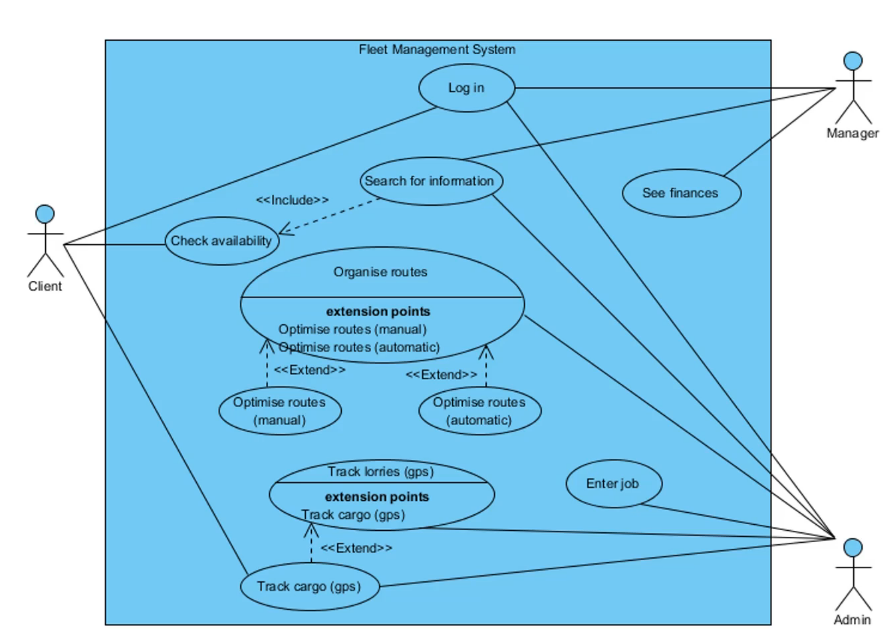
`Actors` - Entities that interface with the system. Can be people or other systems.
`Use case` - Based on user stories and represent what the actor wants your system to do for them. In the use case diagram only the use case name is represented.
`Subject` - Classifier representing a business, software system, physical system or device under analysis design, or consideration.
`Relationships`
> Relationships between use case and actor
>
> 1. Association indicates which actor indicates which use case
>
> Relationship between two use cases
>
> 1. Specifying common functionality and simplifying use case flows
> 2. Using <> or <>
**`<>`**- multiple use cases share a piece of same functionality which is placed in a separate use case.
**`<>`** - Used when activities might be performed as part of another activity but are not mandatory for a use case to run successfully.
**Use case diagram of a fleet logistics management company**
**Base Path** - The optimistic path (best case scenario)
**Alternative Path** - Every other possible way the system can be used/abused. Includes perfectly normal alternate use, but also errors and failures.
Use Case: `Borrow copy of book`
> **Purpose**: The book borrower (BB) borrows a book from the library using the Library Booking System (LBS)
>
> **Pre-conditions**:
>
> 1. The book must exist
> 2. The book must be available
>
> **Base Path**:
>
> 1. LBS requests membership card
> 2. BB provides membership card
> 3. BB is logged in by LBS
> 4. LBS checks permissions / debts
> 5. LBS asks for presenting a book
> 6. BB presents a book
> 7. LBS scans RFID tag inside book
> 8. LBS updates records accordingly
> 9. LBS disables anti-theft device
> 10. BB is logged out by LBS
> 11. LBS confirms that process has been completed successfully
>
> **Alternative Path**
>
> 1. BB's card has expired: Step 3a: LBS must provide a message that card has expired; LBS must exit the use case
>
> **Post conditions for base path**
>
> **Base path** - BB has successfully borrowed the book & system is up to date.
>
> **Alternate Path 1** - BB was NOT able to borrow the book & system is up to date.
## Object Orientated Analysis
**Use case diagrams**
- Describe a set of actions that some system should or can perform in collaboration with one or more external users of the system.
- No attempt to represent an order or a number of executions.
**Use case diagram components**
`Actors` - Entities that interface with the system. Can be people or other systems.
`Use case` - Based on user stories and represent what the actor wants your system to do for them. In the use case diagram only the use case name is represented.
`Subject` - Classifier representing a business, software system, physical system or device under analysis design, or consideration.
`Relationships`
> Relationships between use case and actor
>
> 1. Association indicates which actor indicates which use case
>
> Relationship between two use cases
>
> 1. Specifying common functionality and simplifying use case flows
> 2. Using <> or <>
**`<>`**- multiple use cases share a piece of same functionality which is placed in a separate use case.
**`<>`** - Used when activities might be performed as part of another activity but are not mandatory for a use case to run successfully.
**Use case diagram of a fleet logistics management company**

**Base Path** - The optimistic path (best case scenario)
**Alternative Path** - Every other possible way the system can be used/abused. Includes perfectly normal alternate use, but also errors and failures.
Use Case: `Borrow copy of book`
> **Purpose**: The book borrower (BB) borrows a book from the library using the Library Booking System (LBS)
>
> **Pre-conditions**:
>
> 1. The book must exist
> 2. The book must be available
>
> **Base Path**:
>
> 1. LBS requests membership card
> 2. BB provides membership card
> 3. BB is logged in by LBS
> 4. LBS checks permissions / debts
> 5. LBS asks for presenting a book
> 6. BB presents a book
> 7. LBS scans RFID tag inside book
> 8. LBS updates records accordingly
> 9. LBS disables anti-theft device
> 10. BB is logged out by LBS
> 11. LBS confirms that process has been completed successfully
>
> **Alternative Path**
>
> 1. BB's card has expired: Step 3a: LBS must provide a message that card has expired; LBS must exit the use case
>
> **Post conditions for base path**
>
> **Base path** - BB has successfully borrowed the book & system is up to date.
>
> **Alternate Path 1** - BB was NOT able to borrow the book & system is up to date.