09/10/20
**Multi-level scheduling algorithms**
> Nothing is stopping us from using different scheduling algorithms for individual queues for each different priority level.
>
> - **Feedback queues** allow priorities to change dynamically i.e. jobs can move between queues
> 1. Move to a **lower-priority queue** if too much CPU time is used
> 2. Move to a **higher-priority queue** to prevent starvation and avoid inversion of control.
Exam 2013: Explain how you would prevent starvation in a priority queue algorithm?
The solution to this is to momentarily boost thread A's priority level. This will let A do what it wants to do and release resource X so that B and C can run.
Priority boosting helps avoid control inversion.
**Defining characteristics of feedback queues**
1. The **number of queues**
2. The scheduling algorithms used for individual queues
3. **Migration policy** between queues
4. Initial **access** to the queues
Feedback queues are highly configurable and offer significant flexibility.
**Windows 7**
> An interactive system using a pre-emptive scheduler with dynamic priority levels.
>
> Two priority classes with 16 different priority levels exist.
>
> 1. **Real time** processes/threads have a fixed priority level. (These are the most important)
> 2. **Variable** processes/threads can have their priorities **boosted temporarily**.
>
> A **round robin** is used within the queues.
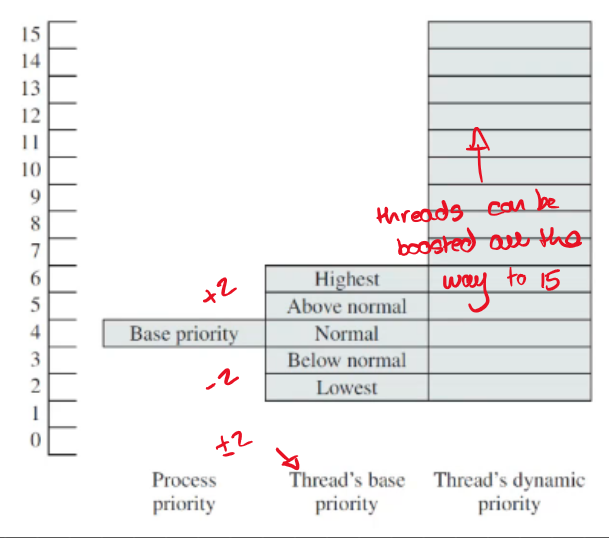
If you give a couple of the threads the highest priority level, you can freeze your computer. (causes starvation for low priority threads)
**Scheduling in Linux**
> Process scheduling has evolved over different versions of Linux to account for multiple processors/cores, processor affinity, and **load balancing** between cores.
>
> Linux distinguishes between two types of tasks for scheduling:
>
> 1. **Real time tasks** (to be POSIX compliant)
> 1. Real time FIFO tasks
> 2. Real time Round Robin tasks
> 2. **Time sharing tasks** using a pre-emptive approach (similar to variable in Windows)
>
> The most recent scheduling algorithm in Linux for time sharing tasks is the **completely fair scheduler**
**Real-time FIFO tasks** have the highest priority and are scheduled with an **FCFS approach**, using pre-emption if a higher-priority job shows up.
**Real-time round robin tasks** can be pre-empted by clock interrupts and have a time slice associated with them.
Both ways *cannot* guarantee hard deadlines.
**Time sharing tasks**
> The CFS (completely fair scheduler) **divides the CPU time** between all processes and threads.
>
> If all N processes/threads have the same priority.
>
> They will be allocated a time slice equal to 1/N times the available CPU time.
>
> The length of the **time slice** and the available CPU time are based on the **targeted latency** (every process/thread should run at least once in this time)
>
> If N is very large, the **context switch time will be dominant**, hence a lower bound on the time slice is imposed by the minimum granularity.
>
> A process/thread's time slice can be no less than the **minimum granularity.**
A **weighting scheme** is used to take different priorities into account.
The tasks with the **lowest proportional amount** of "used CPU time" are selected first. (Shorter tasks picked first if Wi is the same).
**Shared Queues**
A single or multi-level queue **shared** between all CPUs
| Pros | Cons |
| ---------------------------- | -------------------------------------------------------- |
| Automatic **load balancing** | Contention for the queues (locking is needed) |
| | **Cache** becomes invalid when moving to a different CPU |
Windows will allocate the **highest priority threads** to the individual CPUs/cores.
**Private Queues**
> Each CPU has a private (set) of queues
| Pros | Cons |
| -------------------------------------------- | ------------------------------------------------------------ |
| CPU affinity is automatically satisfied | **Less load balancing** (one queue could have 1000 tasks while the other has 4) |
| **Contention** for shared queue is minimised | |
**Related vs. Unrelated threads**
> **Related**: multiple threads that communicate with one another and **ideally run** together
>
> **Unrelated**: processes or threads that are **independent**, possibly started by **different users** running different programs.
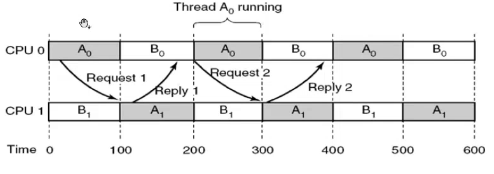
Threads belonging to the same process are cooperating, e.g. they **exchange messages** or **share information**.
The aim is to get threads running as much as possible at the **same time across multiple CPUs**.
**Space Sharing**
> N threads are allocated to N **dedicated CPUs**
>
> N threads are kept waiting until N CPUs are available
>
> **Non pre-emptive** i.e. blocking calls result in idle CPUs
>
> N can be dynamically adjusted to match processor capacity.
**Gang Scheduling**
> Time slices are synchronised and the scheduler groups threads together to run simultaneously
>
> A pre-emptive algorithm
>
> **Blocking threads** result in an idle CPU (if a thread blocks, the rest of the time slice will be unused due to the time slice synchronisation across all CPUs)