A convex hull is where a convex polygon is constructed to bound a set of points on a 2D plane. So, given all points in the set P, what is the smallest convex polygon we can construct that bounds all points in P.
Pseudo code:
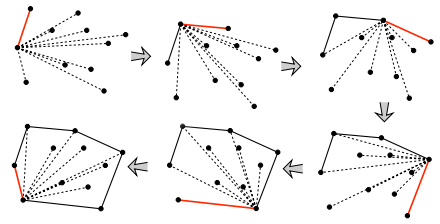
This canvas starts off by generating a set amount of points, placing them at random locations around the screen and adding them to an array. It then finds the index of the point in the array - `vertices[]` - with the lowest x value. It then loops through the array finding all vector's originating from `gamma`, `vec(gammaP(i))`.
We then examine each vertex and evaluate which one is the leftmost from the perspective of point `gamma`. Say in this case `P(q)` is the leftmost vector so we push q onto the stack.
Stack: `((q), (gamma))`
We then repeat until we reach our starting point, which in this case means our starting point is the same as the next point (`q=gamma`)
Now the question of how to calculate the leftness of a vector compared to another. We can use the cross product in 2D.
`vecu times vecv = u``x``*v``y`` - u``y``*v``x` If the cross product is greater than 0, the vector is to the left. If it is equal to 0 then the vectors are colinear
Note: to convert coordinates to a vector, find the difference between your origin point and your target point
Now we just have to add in a little piece of code at the bottom of this function to: increment the iteration number so we don't recurse until eternity, add our leftmost vector to the route stack and call the function again with the next point as a parameter.